AI
The Circus of Circular Financing: Why Circ·Fin, Not AI, Is the Real Bubble
In 2000 I watched the dotcom money go round in circles. In 2026 it's doing laps again. AI isn't the bubble. The money going round it is.
I turned 19 in a bubble
On 23 November 2000 I turned 19. It was a Thursday. The PlayStation 2 landed in UK shops the very next day, which felt like the universe getting my present slightly wrong. In 2026, Grand Theft Auto VI launched on 19 November, four days before my 45th. The universe still can't time my presents. It took an estimated $1.84 billion by launch day, from people spending their own money. Hold that thought.
If you're too young to remember 2000, let me paint it. The internet made a noise when you switched it on. A screeching, bleeping, robot-in-pain noise, and then nobody could use the house phone. The coolest gadget on earth was the Nokia 3310, and its killer app was a snake that ate dots. We had just survived the Millennium Bug, which was meant to drop planes from the sky and mostly did nothing.
If you're old enough to remember, welcome back. You know how it felt.
I was studying for my Diploma with the Institute for the Management of Information Systems. IMIS has since been folded into BCS, the British Computer Society, which tells you how long ago this was. I was learning how information systems worked while the world outside my classroom was betting the house on them.
And what a bet. Stick ".com" on the end of your name and investors threw money at you. Profit was optional. Customers were a nice-to-have. The Nasdaq, the American stock market where tech companies live, hit a record 5,048 on 10 March 2000.
By my birthday in November, the party was already going flat. Pets.com, famous for a sock puppet and not much else, had shut down that same month. By October 2002 the Nasdaq had lost 78% of its value.
I was 19. I didn't lose a penny, because I didn't have a penny. But I watched. And I've been thinking about what I saw ever since.
The trick behind the tent
Here's what most people get wrong about the dotcom crash. They think the internet was the bubble. It wasn't. The internet turned out to be even bigger than the hype said.
The bubble was the money. And in all bubbles, it's always about the money going... pop!
Take Lucent. Lucent made the kit that telecom companies needed to build their networks. Lots of young telecom firms wanted that kit but couldn't afford it. So Lucent lent them the money. Billions of it. They used Lucent's money to buy Lucent's kit, and Lucent wrote it down as sales.
Read that again. It's a shop lending you a tenner so you can buy a tenner's worth of sweets, then telling everyone business is booming.
Two days before my 19th birthday, Lucent admitted it had booked about $125 million of sales it shouldn't have. By December, it had cut $679 million from its sales figures.
Cisco did a version of it. Global Crossing went one better and did deals where it paid money to another company, which spent the same amount straight back with it, so both could call it revenue. The money went out the front door, round the block, and came back in through the window.
It works beautifully right up until one customer can't pay. Then the lender is owed money by someone who's broke, and the "sales" turn out to be a loan that's never coming home. One falls, they all wobble.
That's the bit I remember from 2000. The technology didn't fail. The sums did. Too many of the numbers were the same pound being counted twice.
26 years later, the circus is back in town
On 23 November 2026 I turn 45. And there is a technology advancing faster than the internet ever did. The web took the best part of a decade to reach most homes. AI went from party trick to daily habit in about three years.
I'm not a doubter. I build with AI every single day. I run a venture studio on it. This is not a man shouting at clouds.
But look at how it's being paid for.
In September 2025, Nvidia, which makes the chips AI runs on, said it would put up to $100 billion into OpenAI. OpenAI would then spend most of it on, you guessed it, Nvidia chips. In February 2026, Nvidia's boss said the $100 billion was "never a commitment". Another chipmaker, AMD, handed OpenAI rights to its shares in return for OpenAI buying AMD chips. By July 2026, Nvidia had announced more than $540 billion of deals in this style.
The shop is lending the tenner again. Only now it's a hundred billion dollars.
The polite name for this is circular financing. I'm calling it Circ·Fin, because every bubble deserves a nickname and this one hasn't got one yet.
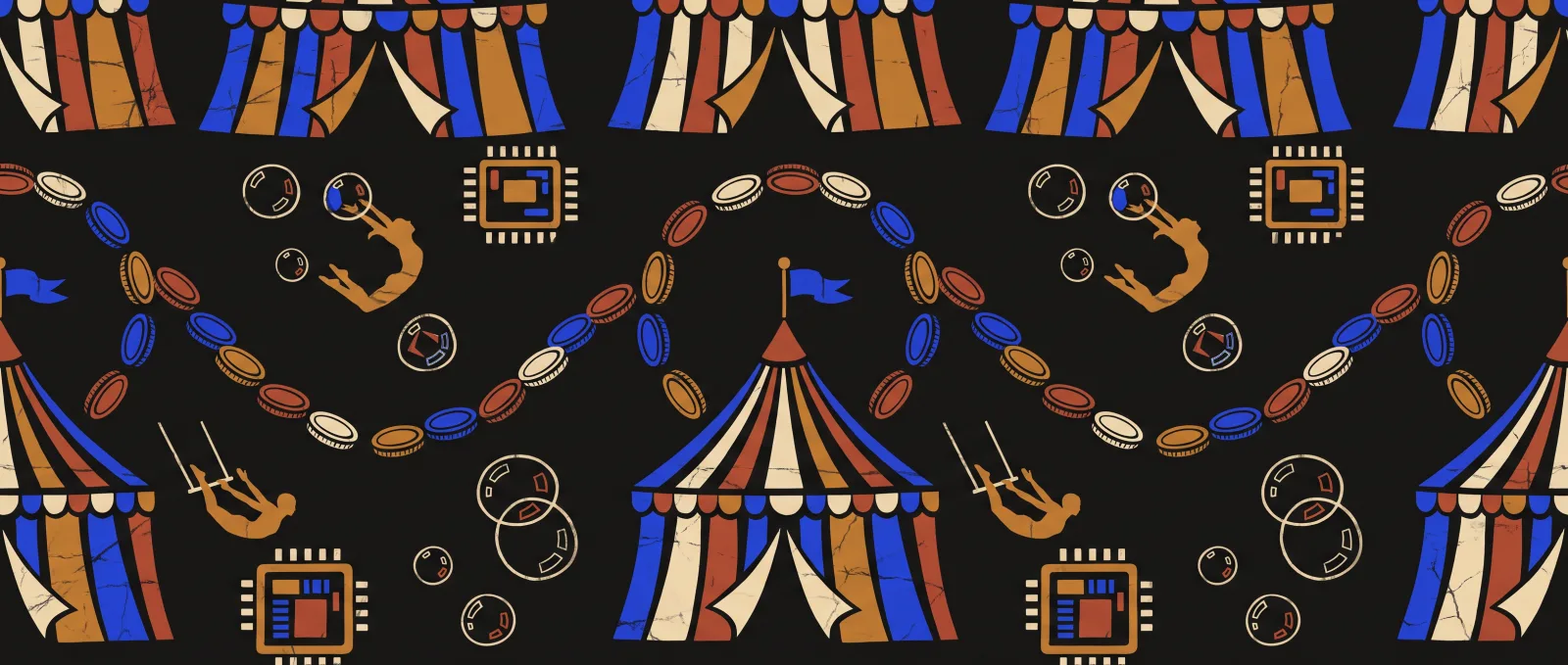
And I'm calling it a circus, because that's what it looks like. Picture it. The ringmaster owns the tent. He also sells the tickets. He also lends the audience the money to buy the tickets. Then he steps into the spotlight and announces a record crowd.
Roll up, roll up.
Jensen Huang, Nvidia's boss until November 2026, called the idea that this is circular "ridiculous". He may well have believed it. But in July 2026, the cost of insuring Nvidia's debt had its biggest one-day jump since that insurance started trading in November 2025. When the ringmaster's own lenders start checking the exits, I pay attention.
As I write this, in the week before my 45th birthday, the tent is wobbling. The S&P 500 fell seven days in a row and slipped into a correction. On Friday 20 November alone, the Nasdaq 100 dropped 5.6% and lost $2.1 trillion, capping its worst week since March 2020. Nvidia is down nearly half from its October peak. And reports say US regulators are now investigating the company.
The safety net has holes
So far, so 2000. Here's where it gets a bit 2008.
Quick history for the younger readers. Before the 2008 crash, banks took thousands of home loans, bundled them up, and sold the bundles to investors. That's called securitisation. Risky debt got parked in side companies so it never showed on the main books. When homeowners stopped paying, nobody knew who was holding the bad stuff. So everybody panicked at once.
Now swap houses for computer chips and data centres.
By the end of 2025, tech firms had moved more than $120 billion of data centre spending off their books in about eighteen months, using side companies. In one Meta deal, roughly $27 billion of debt sits in a vehicle Meta doesn't control, so it doesn't count as Meta's debt.
Then there are loans secured against the chips themselves. One tracker counts $48.4 billion of chip-backed debt in 2026 up to October. For all of 2025 it was $6.6 billion. That's seven times more.
Here's the problem. A house lasts a hundred years. A top AI chip is old news within a few. We are borrowing long against something that ages like a smartphone. Top of the range today. In the kitchen drawer in three years.
And my favourite detail. After 2008, America wrote a rule saying whoever bundles up debt must keep some of the risk themselves. Skin in the game. In July 2026, staff at the US markets regulator agreed that data centre bundles sit outside that rule.
We built a safety net after the last fall. The new act performs just to the left of it.
In 2026, the IMF and the Bank for International Settlements, the bank for central banks, both flagged AI circular financing as a risk to the whole system. These are not excitable people.
The show ends. The tent stays.
Now let me be fair, because doom is optional round here.
AI is real. I'd bet my career on it, and I have. The dotcom crash didn't kill the internet. The networks that bankrupt firms built in 1999 are still carrying traffic today. The builders went bust and the rest of us got a bargain.
So I don't think AI is the bubble. I think Circ·Fin is. Those are two different things, and mixing them up is how people end up either selling everything or believing anything.
The big players can also take a punch. Nvidia makes real profits from real chips. That's a long way from a sock puppet.
But "the tech is real" was true in 2000 too. It didn't save anyone who bought at the top. Amazon survived, won, and its shares still fell around 90% on the way.
Being right about the future and being right about the price are two different jobs.
Zebras don't need a circus
I've written before about zebras: businesses built to last rather than built to be valued. Real stripes, real herd, real grass.
Here's the simplest test I know, and a six-year-old can run it. Where does your money come from?
If it comes from customers who chose to pay you because you fixed something for them, you're a zebra. If it comes from your supplier, who got it from your investor, who is also your supplier's customer, you're in the ring wearing a red nose.
That's the question I now ask of everything I build and everything I back. I've stopped asking how big the round is. I ask who the customer is, and whether the money is theirs.
In 2000 I was 19, watching from a classroom. In 2026 I'm 45, building in the middle of it. The tech this time is better. The money trick is the same old act with bigger numbers.
So enjoy the show. The acrobats are astonishing. Just keep one eye on who paid for your ticket.
Circ·Fin. Remember where you heard it first.
Sources
Nasdaq peak and fall: City AM (opens in a new tab)
Lucent and vendor financing: Lucent annual report FY2000 (SEC) (opens in a new tab); $125m and $679m: Computerworld (opens in a new tab)
Global Crossing, Nvidia and CoreWeave: Fortune (opens in a new tab)
Nvidia and OpenAI $100 billion deal: TechRadar (opens in a new tab)
Huang, "never a commitment": Fortune (opens in a new tab)
AMD warrants: Seeking Alpha (opens in a new tab)
$540 billion of deals, credit insurance jump, Huang quote: The Next Web (opens in a new tab)
Huang's resignation as Nvidia CEO: TechCrunch (opens in a new tab)
Week of 16 to 20 November 2026 (S&P 500 correction, Nasdaq 100, $2.1 trillion): Bloomberg (opens in a new tab)
Nvidia down nearly 50% from its October peak: Bloomberg via Yahoo Finance (opens in a new tab)
SEC investigation reported by the Wall Street Journal: InvestmentNews (opens in a new tab)
$120 billion off the books and the Meta vehicle: e27 (opens in a new tab)
Chip-backed debt tracker: FourWeekMBA (opens in a new tab)
Risk retention rule and data centre bundles: The Next Web (opens in a new tab)
IMF on circular financing: Global Financial Stability Report, October 2026 (opens in a new tab)
BIS on circular financing: The Next Web, June 2026 (opens in a new tab)
Amazon's fall: 24/7 Wall St (opens in a new tab)
IMIS and BCS: Silicon UK (opens in a new tab)
GTA VI launch and the $1.84 billion estimate (Sensor Tower): Fox 5 (opens in a new tab)