Startups · Zebras
Horses and Zebras Will Outrun the Mythical Unicorns in the AI Era
VCs convinced us the only success worth celebrating comes with a £1B+ price tag. But when AI can replace entire departments, that growth funding starts looking like an expensive luxury, not necessity.
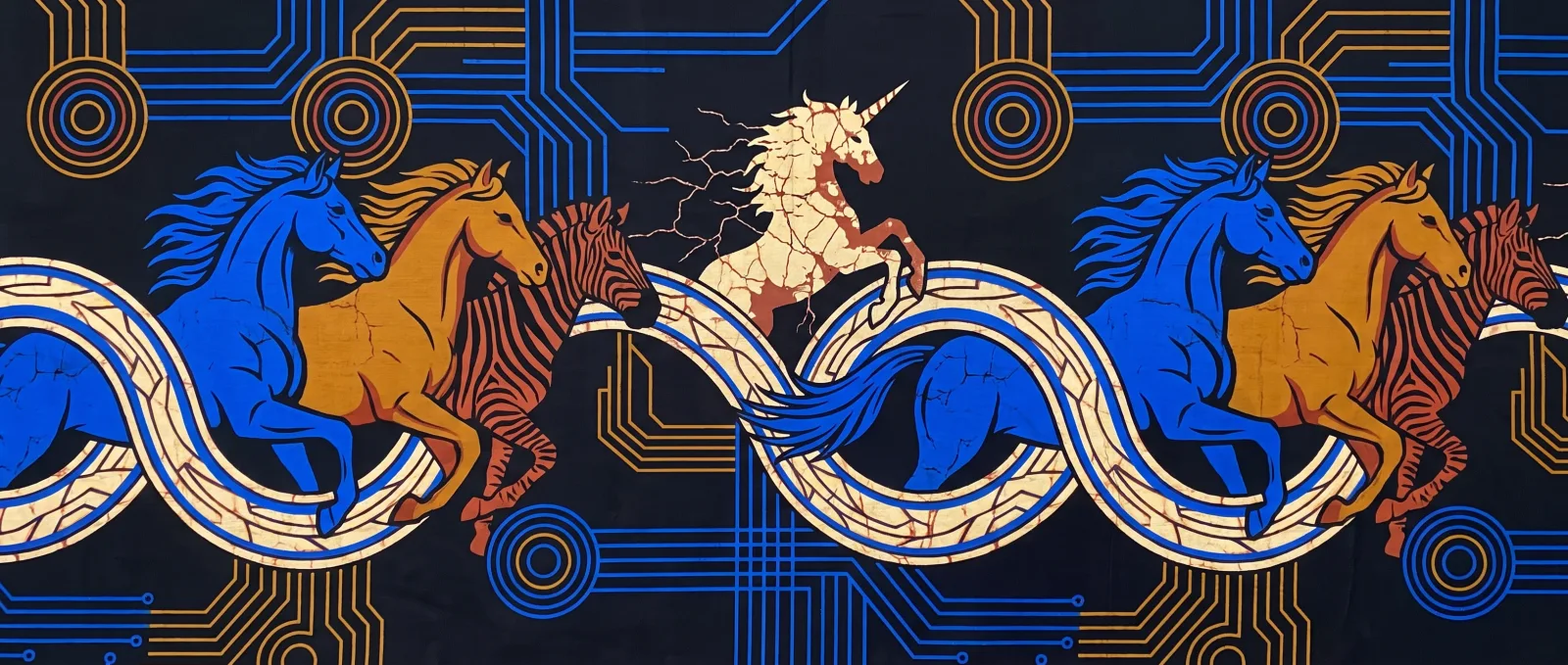
The mythical unicorn. That elusive billion-dollar valuation that founders chase like Donald Trump chasing "USA Liberation" with his Tariffs whilst using a pen crafted in Switzerland to sign the Executive Order, all whilst wearing boxers/briefs and socks made in China (purely speculation, of course).
For years, we've been conditioned to worship at the altar of exponential growth, massive funding rounds, and the gospel of "go big or go home." The venture capital industrial complex has convinced an entire generation that the only success worth celebrating comes with a $1B+ price tag.
When venture capitalist Aileen Lee (opens in a new tab) of Cowboy Ventures (opens in a new tab) coined the term "unicorn" back in 2013 in her TechCrunch article titled "Welcome to the Unicorn Club: Learning from Billion-Dollar Startups (opens in a new tab)", she chose the mythical creature deliberately to symbolise the statistical rarity of startups valued at over $1 billion. At the time, she estimated only 0.07% of software startups founded in the 2000s reached this valuation. She wanted a term that was "readable, fun, and unique" to capture both the magical and statistically rare nature of these startups.
A decade later, unicorns aren't quite so rare anymore. According to data from statista (opens in a new tab) and CB Insights (opens in a new tab), there are between 1,200 and 1,600 companies valued at over $1 billion founded between 2015 and 2025. VCs are determined to make them real, at all costs. But what if I told you that AI is quietly rewriting this narrative? And it isn't just a minor plot twist in startup history - it's an entirely new story.
AI has done something remarkable: it's made the previously unimaginable possible for the solo founder. It's democratised capabilities that once required millions in funding and dozens of specialists. I've always said,
As founders you don't take on venture capital for validation. You take it on for growth. ~ Phin Mpofu-Masamba II (opens in a new tab)
But when AI can replace entire departments, suddenly that growth funding looks like an expensive luxury rather than a necessity. The question is no longer 'How do I get VC funding?' but rather 'Do I even need it?'
The New Taxonomy of Startups: Unicorns, Zebras and Horses
If you've been enamoured by the startup ecosystem for any length of time, you know all about unicorns. I'll provide a short description below for the uninitiated.

Unicorns: The glamorous, VC-backed creatures aiming for billion-dollar valuations and hypergrowth at all costs. They either become legendary (think Airbnb, Uber) or crash spectacularly (remember Zume and Quibi?). Zume, the robotics-driven pizza startup that raised $446 million before collapsing, and Quibi, the short-form streaming platform that burned through $1.75 billion only to shut down after just six months. There's very little middle ground in unicorn land.
But let me introduce you to two other species in our entrepreneurial stables and savannahs:

Zebras: First coined by Astrid Scholz and Jennifer Brandel, zebras are startups that are both profitable AND improve society. Think Mailchimp, which grew profitably for 20 years before any acquisition, or Basecamp and their email service Hey, who've remained fiercely independent while prioritising sustainable growth. Zebras reject the "move fast and break things" ethos in favour of profitability, positive social impact, and longevity. Like actual zebras, they value their independence and survive through cooperation rather than cutthroat competition.

Horses: The reliable workhorses of the business world. Some are wild. Some are tamed. They might never make headlines, but they generate consistent profit, create real jobs, and provide founders with genuine independence and wealth without the constant pressure of 100x returns. These founders aren't on magazine covers, but they're building sustainable businesses on their own terms.
Here's the thing about AI that nobody seems to be talking about: it's dramatically changing which of these animals has the evolutionary advantage.
AI: The Great Equaliser
Back in 2018, building even a modestly sophisticated tech product required significant resources. You needed a team of engineers, designers, product managers, and often subject matter experts. Minimum viable products weren't very "minimum" at all.
Enter 2023 and the AI revolution.
Today, a solo founder with the right AI tools can build what would have required a team of 10-15 people just a few years ago. The leverage is astonishing:
- Code generation tools that produce 95% working solutions from natural language prompts
- AI design tools that can create polished UI/UX from rough sketches
- Marketing copy that converts, generated in seconds
- Customer support systems that handle 80% of queries without human intervention
The capital efficiency is unprecedented. What once cost $500k to build can now be accomplished with $50k or less. This isn't marginal improvement; this is a fundamental reshaping of what's possible.
This shift has made horses and zebras not just viable, but potentially more attractive than unicorns for many founders.
The Hidden Cost of Unicorn Hunting
Let's talk about the VC-to-unicorn route trap that nobody warns you about. It's practically gospel now: to become a unicorn, you must sacrifice your company at the altar of venture capital. The formula seems straightforward - take millions in funding, grow at all costs, and eventually join the billion-pound valuation club. But this unicorn factory has some serious quality control issues that the brochure conveniently omits.
The unicorn trap reveals itself in predictable ways:
- "3x Your TAM" - Suddenly your addressable market must expand dramatically
- "Hire Fast, Hire Big" - Your lean team needs VPs from Google & Meta yesterday
- "Burn Rate as Badge of Honour" - Spending millions becomes a status symbol
- "Exit or Die Trying" - Your timeline to liquidity shrinks while expectations grow
This is the unicorn trap in action. The pressure to contort your original vision into a unicorn-shaped box is relentless and ubiquitous. It's in every podcast, blog post, and conference talk. But here's what nobody tells you in those gleaming VC meeting rooms: pursuing unicorn status fundamentally changes your company, sometimes not always for the good.
Customer Capital: The Ultimate Funding Source
The most underrated form of investment isn't angel, VC, or even grant funding. It's customer capital. Money that comes from people paying you for something valuable you've created.
Customer capital has magical properties:
- It doesn't dilute your ownership
- It forces you to build something people actually want
- It aligns your incentives with your users (not investors)
- It creates sustainable businesses from day one
In the AI era, the path to customer capital has never been more accessible. With dramatically reduced build costs, the gap between idea and revenue-generating product has shrunk to weeks/months rather than years.
Choose Your Animal Wisely
This isn't about saying unicorns are bad and zebras and horses are good. It's about having the clarity to ask: what am I actually building?
If you're creating a genuinely revolutionary product that requires massive scale and the moat being $$$ spent on marketing, infrastructure or research labs, by all means, chase unicorn status.
But if you're building something valuable that solves real problems for a specific market, consider the zebra or horse path. In the AI era, these paths can lead to multi-million dollar businesses without the existential pressure of 100x returns.
The best question I've started asking founders isn't "How big can this get?" but rather "What's the smallest version of this business that you can build quickly thanks to AI tools that would make you happy?"
Build that first. Use AI to do it efficiently. Fund it with customer capital whenever possible.
Because here's the truth: in a world where technology has democratised what we can build, the scarcest resource isn't money, it's purpose and ingenuinty. Building something that matters to you, that serves real customers, and that creates the life you want to live isn't settling. It's winning the game on your own terms.
The AI era gives us this freedom. Use it wisely.
As you can be.