AI · Futurist · Society
The Future of No Work
In 2020, the UK paid 11.7 million people not to work. They baked banana bread, got fitter, and slept better. It was an accidental glimpse of the future. The question is: who's picking up the tab?
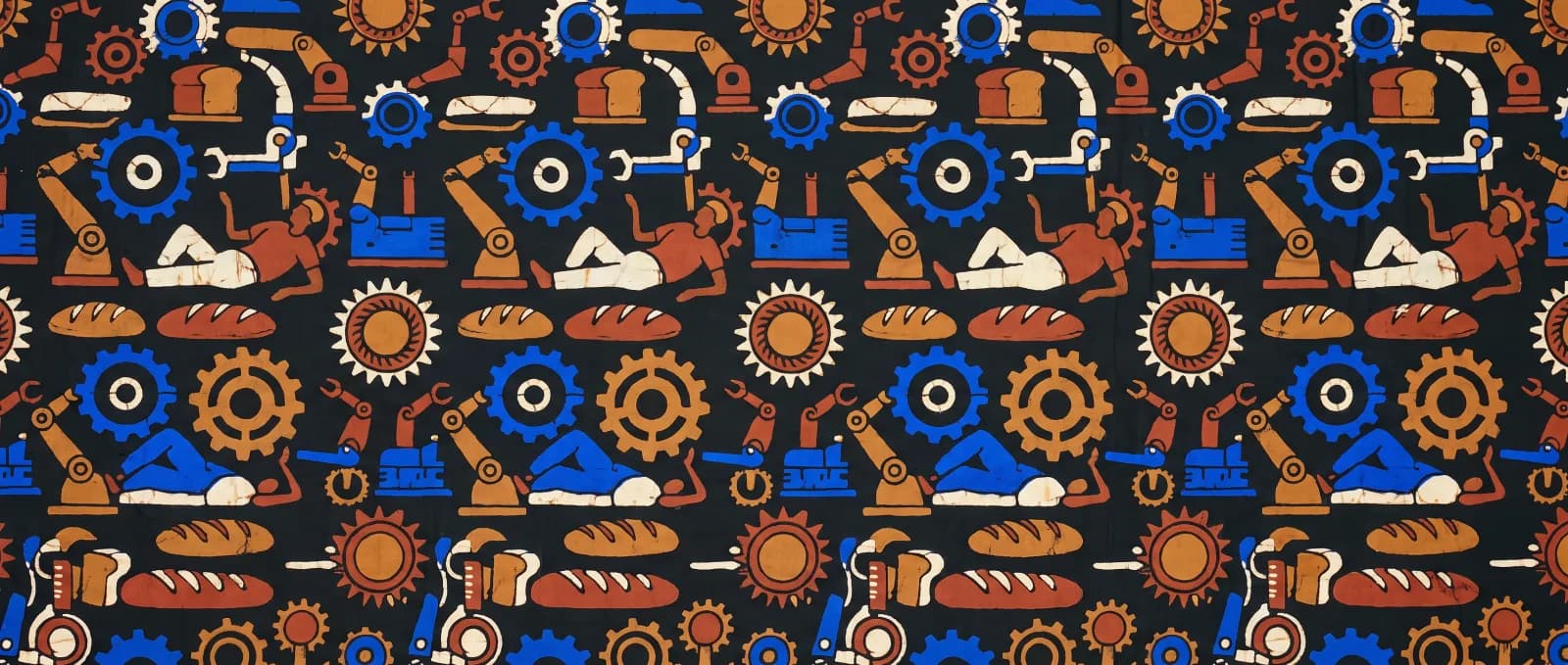
In April 2020, the same scene was playing out in hundreds of thousands of kitchens across Britain. Someone standing at the counter, dusted in flour, pulling a loaf of banana bread from the oven and photographing it like it belonged in a gallery. And through the window behind them, the street outside was completely empty. No cars. No people. Just stillness.
Those home bakers, along with 11.7 million other furloughed workers in the UK, were part of something none of us recognised at the time: the largest accidental social experiment in modern history. The government paid £70 billion to find out what happens when you give millions of people 80% of their wages and absolutely nothing to do.¹
The results were fascinating. People exercised more. They ate better. They slept longer. Research across eight longitudinal studies confirmed it: furloughed workers genuinely improved their health behaviours compared to those who kept working.² Google searches for banana bread recipes went up 84%.³ Joe Wicks became a national institution. For a brief, strange, terrifying moment, we caught a glimpse of what the leisure society might actually look like.
And then we all went back to work. As fast as we could.
Well, sort of.
Because while the furloughed returned to their jobs, millions of other workers never went back to the office. They just opened their laptops at the kitchen table and carried on. Before COVID, only around 12% of UK workers regularly worked from home.⁴ By April 2020, nearly half the workforce was doing it.⁵ And when the dust settled, it stuck. By 2022, just 25% of London workers were going in five days a week, down from 62% before the pandemic.⁶ Office workers who previously averaged 3.8 days a week in the building were now averaging just 1.6.⁷
This was social experiment number two. And it answered a question that corporate Britain had been avoiding for decades: do knowledge workers actually need to be in the office?
The answer, it turned out, was mostly no. Two-thirds of employees reported getting as much or more done from home. Sickness absence rates for homeworkers were less than half those of office workers.⁸ Companies cited improved staff wellbeing as the number one reason to keep remote work. Productivity, for the most part, held. In some sectors, it went up.
But here's the thing nobody said out loud at the time. If your knowledge workers don't need to be in the building to do their jobs, a far more uncomfortable question starts forming in the background. One that most people weren't ready to hear yet.
Do you need all of those knowledge workers at all?
On 30 November 2022, a small San Francisco company called OpenAI quietly released a chatbot called ChatGPT. Within five days it had a million users. Within two months, a hundred million. It became the fastest-growing consumer application in the history of the internet. Faster than TikTok. Faster than Instagram.⁹
And just like that, the question that work-from-home had whispered, AI screamed.
Because ChatGPT could write. It could summarise. It could analyse data, draft reports, debug code, translate documents, and hold a reasonably convincing conversation about contract law. Not perfectly. Not every time. But well enough to make a lot of people very uncomfortable. The kind of tasks that filled the calendars of copywriters, analysts, paralegals, junior consultants, and middle managers were suddenly being done in seconds, for free, by a machine that never called in sick and never asked for a pay rise.
That was just the beginning. Since November 2022, the pace has been relentless. GPT-4 arrived. Then Claude. Then Gemini. Then dozens more. Each iteration more capable than the last. The World Economic Forum's Future of Jobs Report 2025 found that 86% of employers expect AI to transform their business by 2030, with 40% anticipating a reduction in their workforce.¹⁰ Research from the University of Pennsylvania estimates 42% of all current jobs are exposed to AI automation.¹¹ For roles that AI can already perform entirely, employment is already falling.
These aren't projections for 2040. This is happening now.
And then came the agents.
If ChatGPT was a very clever assistant you could talk to, agentic AI is the colleague you can delegate to. We've moved well beyond chatbots that answer questions. We're now building autonomous systems that reason, plan, and execute multi-step tasks with minimal human oversight. They don't just respond. They act.
AI agents can now write and ship production code. They can conduct financial analysis across thousands of data points. They can process legal documents, manage customer service workflows, generate and A/B test marketing campaigns, and synthesise research papers into strategic recommendations. The "human in the loop" hasn't disappeared entirely, but it's shrinking fast. In many cases, all you need is a handful of domain experts providing feedback, not a department.
I'll give you a personal example. I run a venture studio, and one of our platforms, TRUVERI, tracks and verifies property professional transactions across the UK. The kind of analysis it requires, sifting through Companies House filings, cross-referencing Land Registry data, building leaderboards from hundreds of thousands of transactions, would have required a team of analysts not long ago. Salaried professionals with desks, pensions, and parking spaces. Today, I run an AI Agent Analyst that handles much of that heavy lifting. The cost? Less than £10 a month. Less than a Netflix subscription.
Multiply that across every company, in every industry, in every country, and you begin to see the true scale of what's arriving. This isn't a future scenario. It's a Tuesday.
So let's trace the arc.
In 2020, the government proved you could pay people not to work, and they'd bake banana bread, exercise more, and sleep better. In 2021, the corporate world proved that knowledge workers didn't need to be in an office. In 2022, a chatbot proved that a machine could do a significant chunk of what those knowledge workers were being paid for. And by 2025, autonomous AI agents are proving they can do it faster, cheaper, and at scale, with a few human experts providing direction rather than a full headcount.
No work. Work from home. AI-boosted productivity. No work.
The circle is closing. And it's closing faster than anyone predicted, including John Maynard Keynes, who back in 1930 forecast that by now we'd only need to work 15 hours a week.¹² He got the destination right. He just didn't foresee the route.
Now here's where the dream of leisure runs headfirst into the machinery of modern capitalism.
UK household debt currently stands at over £2 trillion.¹³ Average household debt, excluding mortgages, has doubled in a decade to around £18,000.¹⁴ Some 84% of UK adults hold some form of credit or loan.¹⁵ And perhaps the most telling statistic of all: 57% of people currently experiencing problem debt are in full-time employment.¹⁶ Work isn't even solving the financial problem anymore.
Our entire economic model rests on a simple loop: people work, earn money, pay taxes, service debt, and consume. Remove work from that equation and the loop breaks. If AI displaces 40% of jobs, who funds public services? If millions stop earning, who services those trillions in loans? The tech optimists talk about Universal Basic Income as though it's simply a matter of political will. But UBI at any meaningful scale would dwarf every existing government programme, and nobody has convincingly explained where the money comes from.
Then there's a subtler danger that fewer people are talking about. Our financial system is increasingly run by algorithms in conversation with other algorithms. In 2010, the "Flash Crash" wiped $1 trillion off US markets in under five minutes.¹⁷ One algorithmic trading error. One cascade. One trillion dollars. Gone and back again before most people finished their morning coffee. Now imagine those systems are not just trading stocks but managing debt portfolios, mortgage approvals, and credit decisions for millions of households. AI in finance creates what researchers call a "monoculture risk": when every institution uses similar models reading the same data, they all reach the same conclusions at the same time. Efficient in calm waters. Catastrophic in a storm.
In 1930, Keynes imagined we'd choose leisure once we had enough. He underestimated something far more powerful than compound interest: the human need to feel useful, to compete, to define ourselves by what we produce. When someone asks "What do you do?" they're not really asking about your calendar. They're asking who you are.
But it may not matter what we choose. The choice might be made for us. COVID showed us that when you give people time, they create. They bake, they move, they connect. Work from home showed us that the office was optional. And AI is now showing us that the worker might be too.
The furlough cost £70 billion. The bill for the AI revolution will make that look like a rounding error.
The question Keynes asked in 1930 remains the right one: how do we live wisely and agreeably and well? But nearly a century later, there's a follow-up he never thought to ask.
Who's picking up the tab?
References
¹ National Audit Office, "COVID-19: The Coronavirus Job Retention Scheme" (2024). 11.7 million unique employments furloughed; total cost £70 billion; 80% of wages covered up to £2,500/month. nao.org.uk (opens in a new tab)
² Wielgoszewska, B. et al., "The UK Coronavirus Job Retention Scheme and diet, physical activity, and sleep during the COVID-19 pandemic: evidence from eight longitudinal population surveys," BMC Medicine, 20, 147 (2022). doi.org/10.1186/s12916-022-02343-y (opens in a new tab)
³ Google Trends data (April 2020), as reported in Refinery29 UK. UK searches for "banana bread" rose 84% in 30 days; worldwide searches rose 54%. refinery29.com (opens in a new tab)
⁴ Office for National Statistics, "Characteristics of homeworkers, Great Britain: September 2019 to January 2020." Around 12% of working adults reported working from home in the reference week. ons.gov.uk (opens in a new tab)
⁵ Office for National Statistics, Opinions and Lifestyle Survey (2020). 49% of working adults reported having worked from home in the period 3-13 April 2020. ons.gov.uk (opens in a new tab)
⁶ King's College London Policy Institute, "The Great Resistance: Survey of working in London" (June 2022). In Feb/March 2022, only 25% of London workers did not work from home at all, down from 62% in Jan/Feb 2020. kcl.ac.uk (opens in a new tab)
⁷ Advanced Workplace Associates (AWA), Hybrid Working Index (2023), as reported in People Management/CIPD (August 2023). Pre-pandemic average: 3.8 days per week in the office. Post-pandemic UK average: 1.6 days per week. peoplemanagement.co.uk (opens in a new tab)
⁸ Office for National Statistics, "Homeworking hours, rewards and opportunities in the UK: 2011 to 2020" (April 2021). Sickness absence rate: 0.9% for homeworkers vs 2.2% for those who never worked from home. Self-reported productivity and employer surveys: around two-thirds of employees working from home reported equal or better output. ons.gov.uk (opens in a new tab)
⁹ Reuters/UBS (February 2023). ChatGPT launched 30 November 2022; reached 1 million users in 5 days; 100 million monthly active users by January 2023. UBS analysts described it as the fastest-growing consumer application in internet history. reuters.com (opens in a new tab)
¹⁰ World Economic Forum, "Future of Jobs Report 2025" (January 2025). 86% of employers expect AI and information processing technologies to transform their business by 2030; 40% anticipate workforce reductions in roles displaced by AI. weforum.org (opens in a new tab)
¹¹ Eloundou, T. et al., "GPTs are GPTs: An Early Look at the Labor Market Impact Potential of Large Language Models," University of Pennsylvania / OpenAI (2023). Estimates approximately 80% of the US workforce could have at least 10% of their work tasks affected by LLMs; roughly 42% of total worker tasks are exposed to AI automation. arxiv.org (opens in a new tab)
¹² Keynes, J.M., "Economic Possibilities for our Grandchildren" (1930). Predicted that within 100 years, technological progress would reduce the working week to around 15 hours.
¹³ PwC Strategy& UK Consumer Credit Confidence Report (2024); Office for Budget Responsibility, March 2025 forecast. UK household debt (all types) surpassed £2 trillion; OBR projects £2,332 billion in Q1 2025. pwc.co.uk (opens in a new tab)
¹⁴ NimbleFins analysis of Bank of England and ONS data (2025). Average total UK household debt excluding mortgages: approximately £18,392, an increase of 98% over ten years. nimblefins.co.uk (opens in a new tab)
¹⁵ Financial Conduct Authority, Financial Lives Survey 2024, via House of Commons Library. Around 84% of UK adults had some form of credit or loan in the 12 months to May 2024. commonslibrary.parliament.uk (opens in a new tab)
¹⁶ StepChange Debt Charity, Statistics Yearbook 2024 (April 2025), based on YouGov polling of 4,613 UK adults (January 2025). 57% of UK adults experiencing problem debt were in full-time employment. medium.com/stepchange (opens in a new tab)
¹⁷ U.S. Securities and Exchange Commission / Commodity Futures Trading Commission, "Findings Regarding the Market Events of May 6, 2010" (September 2010). The Flash Crash of 6 May 2010 saw approximately $1 trillion temporarily wiped from US equity markets in under five minutes. sec.gov (opens in a new tab)