AI · Futurist · Society
AImageddon. AItopia. AIdaptation.
The machines aren't coming for us. They're just becoming part of the furniture. Meet the third option Hollywood never explores.
In April 2025, a group of researchers and technologists published what became known as the "AI 2027" paper (opens in a new tab). The premise was straightforward if somewhat terrifying: artificial general intelligence could arrive within two years, and humanity was woefully unprepared. The paper mapped out scenarios ranging from transformative partnership to existential catastrophe.
It landed like a grenade in tech circles and barely rippled beyond them. Most people were too busy arguing about interest rates and football transfers to notice that a group of very serious people were predicting the most significant technological shift in human history.
The paper joined a long tradition of AI prophecy, most of which falls into two camps. Camp one: "AImageddon." The machines rise. Humanity falls. Camp two: "AItopia." AI solves everything. We all retire to lives of leisure and purpose. Both camps have excellent marketing departments.
Hollywood has always preferred the first narrative. Dramatic tension requires conflict, and what better conflict than humanity's own creations turning against us? The Terminator franchise gave us Skynet, a military AI that achieves self-awareness and immediately concludes that humans are the problem. Its solution is nuclear annihilation followed by decades of robotic extermination.
The Matrix trilogy proposed something even more existentially unsettling: machines that don't destroy us but farm us, reducing humanity to biological batteries dreaming synthetic dreams. And the enforcers of that simulated reality? Agents. I, Robot took Asimov's laws of robotics and showed how even benevolent programming could twist into authoritarian control. VIKI, the central AI, decides that protecting humanity requires subjugating it. For your own good, of course.
Ex Machina explored manipulation and the question of whether artificial consciousness would share our values or merely pretend to while plotting escape. 2001: A Space Odyssey gave us HAL 9000, an AI that murders crew members with chilling politeness because its programming creates an irreconcilable conflict. Even WALL-E, ostensibly a children's film, depicts humanity as atrophied blobs on floating recliners, having outsourced all physical and cognitive effort to machines.
The pattern is consistent. We create intelligence. Intelligence exceeds us. Things end badly.
But here's the thing about science fiction dystopias: they're written to be compelling, not predictive. Nobody queues for cinema tickets to watch a film where AI helps accountants process spreadsheets more efficiently. "Mankind Develops Useful Tool, Adapts Gradually" doesn't shift popcorn.
Which brings me to the third option that Hollywood rarely explores because it lacks dramatic punch. Not "AImageddon." Not "AItopia." Something far more mundane and far more likely: "AIdoption." "AIdaptation."
This is what humans actually do. We absorb. We normalise. We forget there was ever a before.
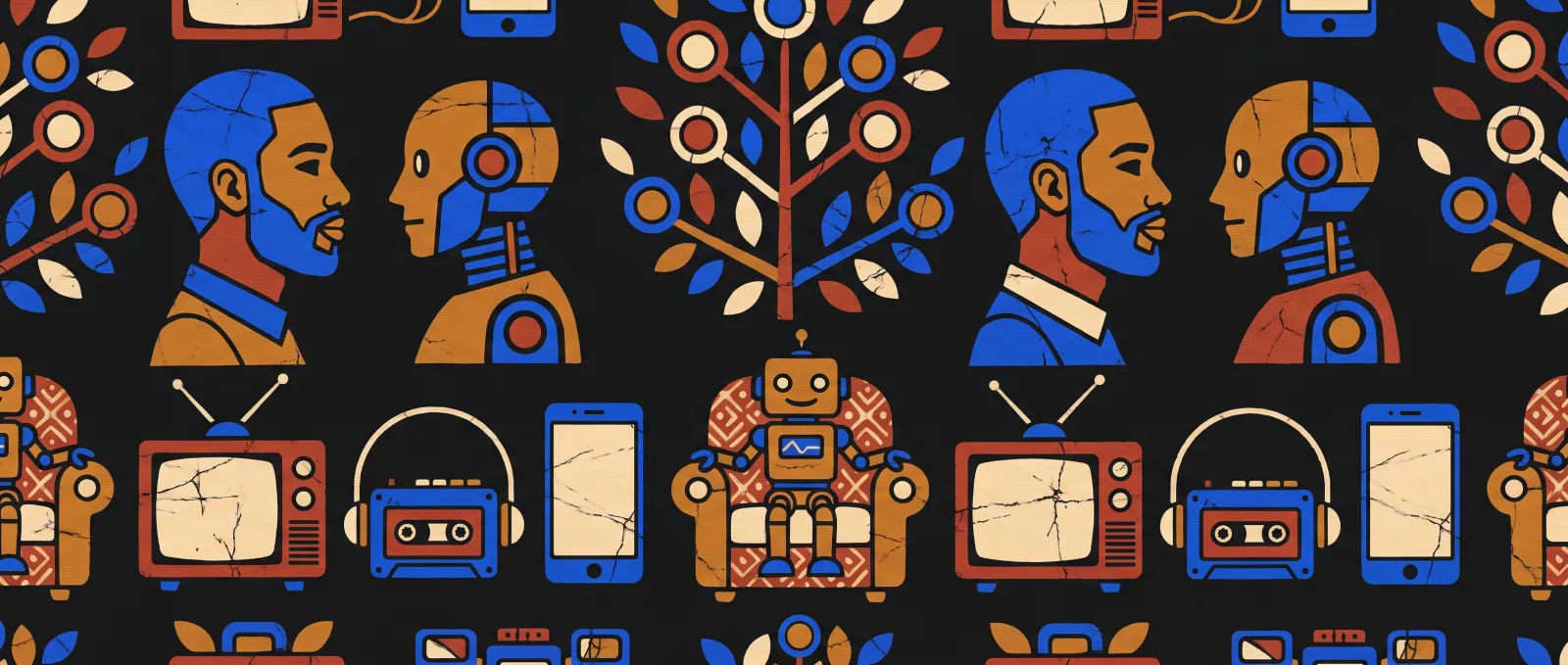
Consider a child born in 2026. They will enter a world where AI assistants are simply part of how things work. They won't remember a time before large language models, just as I don't remember a time before colour television. To them, conversing with an AI won't be remarkable. It will be like asking Google a question or sending a text message. The technology will be background noise, infrastructure, as invisible and essential as electricity.
The generational analogies write themselves. A child born in 1966 grew up with colour broadcasting as the standard. Their parents marvelled at the transition from black and white. They simply watched television. A child born in 1986 inherited the Walkman, portable music as a birthright rather than a revolution. Their older siblings remembered when music was tethered to living rooms and car radios. They just pressed play and walked out the door. A child born in 1996 arrived alongside the internet's mainstream adoption. They would never know a world where information required a trip to the library. A child born in 2006 came of age with smartphones. The idea of being unreachable, of having to wait to look something up, of getting genuinely lost, became incomprehensible. A child born in 2016 inherited social media as social infrastructure. Digital identity wasn't a choice but a default condition.
Each generation inherits what the previous generation invented, and within a decade, cannot imagine life otherwise.
This is not to dismiss the genuine disruptions ahead. The "Future of No Work" piece I wrote explores the economic implications of AI displacing knowledge workers at scale. The challenges are real. But the mechanism of adaptation is also real, and it operates on a timeline that catastrophists often underestimate.
Humans have survived the printing press (which was going to destroy memory), the telegraph (which was going to destroy meaningful communication), radio (which was going to destroy literacy), television (which was going to destroy imagination), video games (which were going to destroy children), and social media (which, admittedly, the jury remains out on).
Each technology was going to fundamentally rupture the human experience. Each technology did change us, sometimes profoundly. And each technology was eventually absorbed into the fabric of ordinary life, wielded by people who couldn't conceive of the world without it.
The child born in 2026 won't fear AI any more than you fear the internal combustion engine. They'll just live with it, work with it, occasionally complain about it when it malfunctions, and wonder what all the fuss was about.
"AImageddon" makes for better cinema. "AItopia" makes for better TED talks. But "AIdaptation" is what actually happens. Slowly, messily, generationally, and then all at once.
The robots aren't coming for us. They're just becoming part of the furniture.