AI
The AI Productivity Paradox That No One Is Really Talking About
Remember when mobile phones promised to save us time and make us more productive? Yet somehow, we ended up working longer hours, being perpetually available, and drowning in notifications.
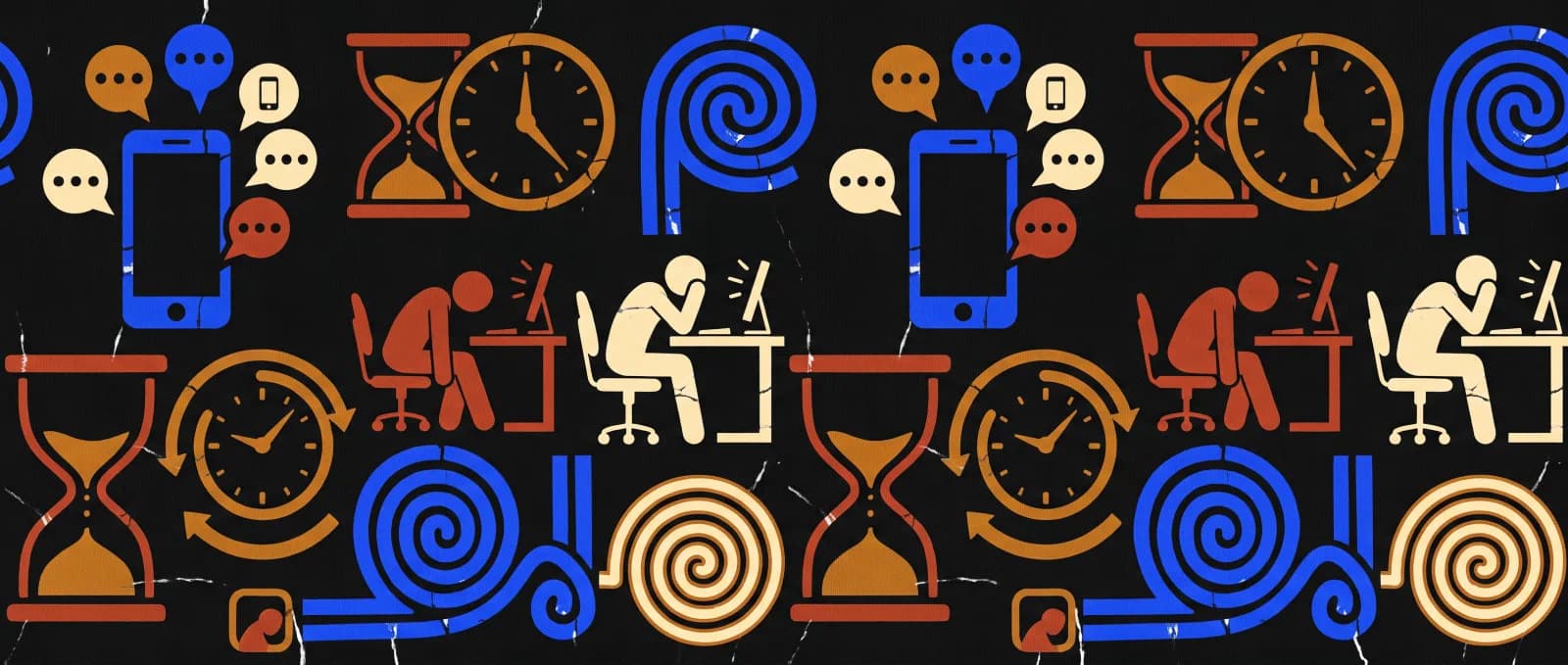
Remember when mobile phones promised to save us time and make us more productive? Yet somehow, we ended up working longer hours, being perpetually available, and drowning in more notifications than any human was designed to handle. We didn't get more free time; we just filled the void with more tasks.
AI productivity tools are giving us that same mobile phone moment all over again, and it's time we talked about it.
The Great Content Tsunami
Let's start with an uncomfortable truth: your LinkedIn feed has likely transformed into an endless scroll of suspiciously polished posts. Newsletters multiply like digital rabbits. Everyone's a thought leader now, courtesy of our AI writing assistants.
I'm guilty of it too. This very article was written thanks to Claude, my AI writing assistant, and the graphics created by ChatGPT. The whole task completed in under 3 hours. I had always wanted to write previously, but the thought and time needed would have meant pre-AI this article would have taken me 16 to 20 hours to complete over 3 to 4 days. Ain't nobody got time for that.

The viral meme of Kimberly "Sweet Brown" Wilkins being interviewed after having escaped a fire in an apartment complex. It originally aired on April 8, 2012, on Oklahoma City NBC affiliate KFOR-TV
My founder mates Jack Porter (opens in a new tab) and Noah Jacobs 🐦🐕 (opens in a new tab) of BirdDog (opens in a new tab) talk often about this phenomenon of "AI Slop." It's content created at scale, often indistinguishable from genuine insight, flooding every platform with a tsunami of sameness.
My Personal Productivity Paradox
As someone building in the AI space with Ugenie (opens in a new tab) (our next-gen discovery and attribution social shopping platform), I've experienced this firsthand. My productivity has skyrocketed. I'm writing this newsletter thanks to Claude AI and ChatGPT (opens in a new tab), producing "Day in the Life of a Founder"#DITLOAF content thanks to Canva (opens in a new tab) and CapCut (opens in a new tab), coding features thanks to Cursor (opens in a new tab), filling and managing the TOFU (Top of Funnel) of our Fashion Content Creators thanks to HubSpot (opens in a new tab) and managing countless other tasks simultaneously. I've never shipped more work as a solo founder.
But here's where it gets interesting: my bank balance hasn't gotten the memo about my increased productivity. I'm doing more, creating more, writing more, yet the financial rewards haven't scaled proportionally. This reveals our first paradox: when everyone becomes more productive, the value of that productivity can actually decrease.
When Supply Outpaces Demand
It's basic economics: when supply increases dramatically while demand remains relatively stable, the value drops. Content creation has become almost frictionless, but human attention remains stubbornly finite. There are still only 24 hours in a day, no matter how much AI helps us create.
This leads to an uncomfortable question: are we confusing activity with achievement? AI makes it trivially easy to produce more. More emails. More reports. More code. More strategy documents. But productivity isn't just about volume.
I can now produce a week's worth of social media content in a few hours. I can draft a privacy policy in minutes rather than days. I can implement features into the Ugenie (opens in a new tab) platform exponentially faster with Cursor. Yet the truly meaningful work (building relationships with creators & brands, making it easy and rewarding for consumers to shop, refining my vision for Ugenie | Next-Gen Social Shopping & Attribution (opens in a new tab), making strategic decisions) still takes just as much time and human thought as ever.
The Synthetic Data Cycle
Then things get even weirder and more paradoxical. The content we're creating with AI assistance is, by definition, somewhat synthetic. It's built from patterns observed in existing human work. Then this synthetic content gets published online, where it will likely be scraped to train the next generation of AI models.
Can you see where I'm going with this? We're potentially heading for a feedback loop where AI increasingly learns from AI-influenced content rather than purely human creativity. The scary part isn't just that we know what will happen, it's that we don't. Will this synthetic-to-synthetic loop amplify certain patterns while diminishing others? Will subtle AI biases compound with each generation? Or might it actually refine and improve certain types of content? We're in completely uncharted territory here, running a global experiment without fully understanding the implications.
This isn't just a philosophical concern. As AI models train on more synthetic data, we risk entering what researchers are starting to call "model collapse," where each generation of AI learns increasingly from the outputs of previous AIs rather than from diverse human creativity.
The Pushback Begins
The backlash has already begun. On LinkedIn (opens in a new tab), people are up in arms about AI-generated posts. "I can spot AI content from a mile away," they claim (ironically, often in posts that themselves have the telltale signs of AI assistance). The platform has become a battleground between those embracing AI productivity and those resisting it.
And this resistance makes perfect sense. When the barrier to content creation drops to nearly zero, how do we signal genuine expertise? How do we separate thoughtful analysis from well-formatted fluff?
This question is particularly acute for those of us building in public. If everyone can produce polished thought leadership at scale, what remains valuable is authentic perspective, genuine experience, and unique insight, precisely the things AI can help express but cannot generate on its own.
The False Productivity Trap
There's a deeper issue at play, what I'm calling the "false productivity trap." We're becoming incredibly efficient at producing outputs that might ultimately not matter.
Think about it this way: if you suddenly gained the ability to write ten times more emails per hour, would your impact increase proportionally? Or would you just send more emails that get less attention?
I've had days where I've felt like a productivity superhero, cranking out code, content, and communications at unprecedented speed. Yet by week's end, I've sometimes wondered if all that output actually moved the needle on what truly matters for Ugenie's growth.
This isn't to dismiss AI's genuine benefits. The technology has democratised capabilities that were once available only to well-resourced teams. Now a solo founder like me can punch far above their weight class across multiple domains. What I am suggesting is that AI has dramatically lowered the barrier to entry across countless fields, allowing us to become competent at things we've never formally studied.
But we need to be honest about the difference between velocity and progress.
Finding Balance in the Age of Artificial Productivity
So where does this leave us? How do we harness the undeniable benefits of AI-enhanced productivity without falling into the trap of meaningless output inflation?
I'm still figuring this out myself, but here are a few principles I'm trying to follow:
- Value depth over breadth- Rather than creating more content across more channels, focus on adding genuine insight to fewer pieces.
- Let AI handle the commoditised tasks- Use AI for the formulaic work (formatting, editing, research gathering) while preserving your human creativity for what matters.
- Measure impact, not output- Track conversions, customer satisfaction, and genuine engagement rather than volume metrics.
- Be transparent about AI use- This doesn't mean disclaiming every AI-assisted email, but being honest about where and how you're using these tools.
- Invest the time saved into genuinely human activities- Use your newfound productivity to deepen relationships, improve your thinking, and solve meaningful problems.
The truth is, in a world where everyone has access to roughly the same AI productivity tools, the competitive advantage shifts from "who can produce more" to "who can think more clearly about what's worth producing in the first place."
The Creator Entrepreneurship Opportunity
This brings me back to a point I've been making throughout this newsletter series: creator entrepreneurship isn't just a trendy alternative to traditional employment, it's potentially the most resilient strategy in an AI-saturated world.
When tools make production easier, curation and perspective become more valuable. The ability to decide what's worth creating, to bring authentic human experience to your work, and to build genuine connections with your audience becomes the real differentiator.
For solo founders and creator entrepreneurs, this means focusing less on sheer output and more on developing the unique perspective that no AI can replicate. It means using AI to handle the mechanical aspects of creation so you can invest more in the truly human elements.
As for me, I'll keep using AI to enhance my productivity as a solo founder building Ugenie (opens in a new tab). I'll keep writing these newsletters with AI assistance. But I'm increasingly focused on ensuring that what I create, whether with AI help or not, adds genuine value rather than just adding to the noise.
Because ultimately, productivity isn't about doing more things. It's about doing more of the right things.
As you can be.