AI · Society
Primary Colours of Creativity: Is AI "Stealing" Art or Just Learning Like We Do?
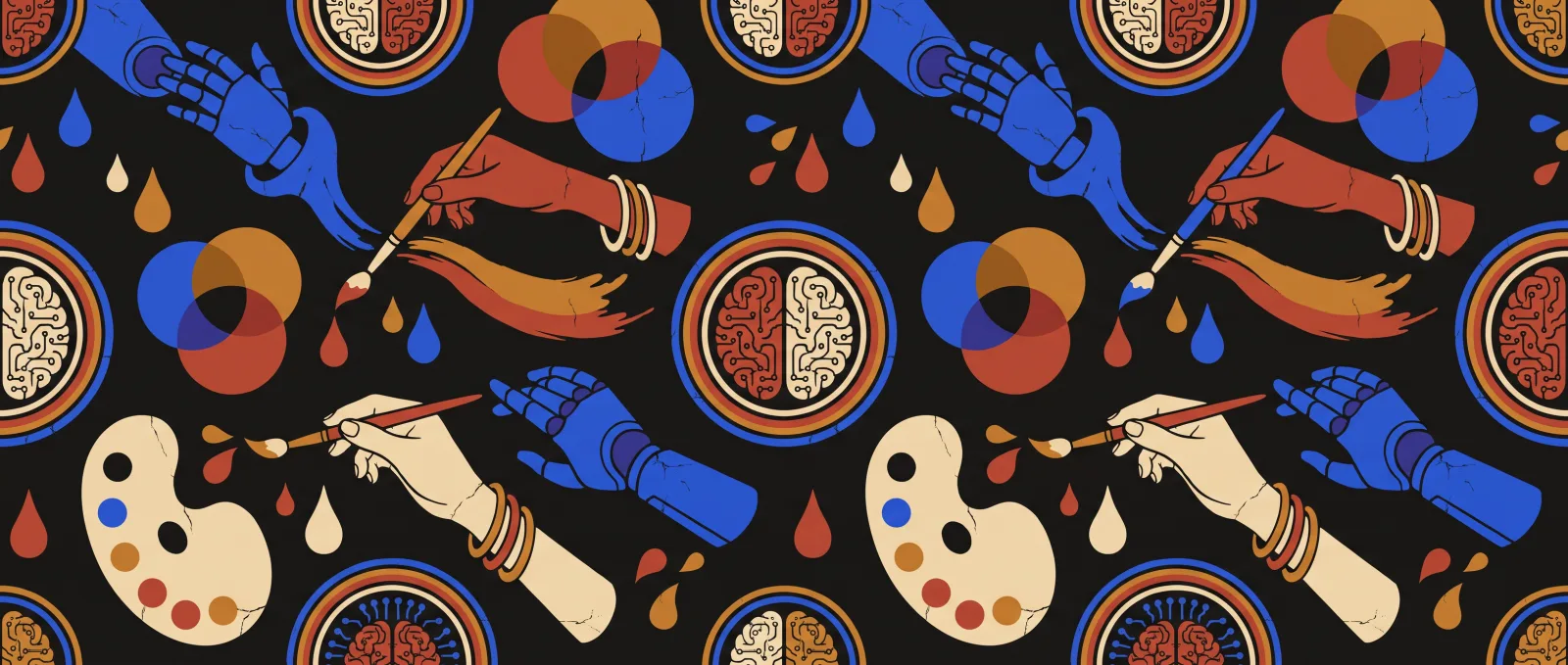
It's not black and white. It’s not grey, either. It's a complex blend of primary colours, mixing together to create thousands of possible shades.
It's not black and white. It’s not grey, either. It's a complex blend of primary colours, mixing together to create thousands of possible shades. That's the simple answer, and honestly that's all you need to know, so you can stop reading now and get on with your day.
Still here? Brilliant. Let’s go deeper. Let's dive into one of the most heated debates in creative circles right now: Is AI pinching the work of artists, or is it simply learning the way humans have done for centuries?
I had a very thoughtful and fascinating exchange on LinkedIn recently with Jade Oakley (opens in a new tab) (you can read it here (opens in a new tab)). We’re both on the Exchange Programme delivered by Department Bonded Warehouse and both attended the SXSW London (opens in a new tab) Roadshow Showcase in Manchester recently, which is what sparked the conversation. She went in as a self-described "passionate sceptic" about AI in creative industries, believing that "human creativity such as art, music and poetry should be left alone" and that "we need to keep the very core of what makes us human sacred."
Fair play. I get it. There's something deeply unsettling about machines generating art that feels like it's mimicking human expression.
But here's the thought that keeps rattling around my brain: How different is AI's learning process from our own?
The Human Learning Process
If I wanted to become a painter tomorrow (God help the art world), I'd start by studying the masters. I'd analyse Van Gogh's brush strokes, marvel at Picasso's perspective, get lost in Turner's atmospherics. I'd copy their techniques, understand their patterns, and eventually create new works heavily influenced by what I've absorbed.
No one would call this theft. We'd call it learning. Apprenticeship even. Finding your voice through understanding others.
Every Beatles song was influenced by Chuck Berry and Little Richard. Timbaland's futuristic productions carry the DNA of Quincy Jones' perfectionism. JAY-Z openly built on Biggie's blueprint. Stormzy carries the torch lit by Dizzee Rascal and Wiley in UK grime. Adele's soulful vocals channel Amy Winehouse who herself was inspired by Etta James.
Look at modern fashion: The late great Virgil Abloh's work at Louis Vuitton borrowed heavily from streetwear pioneers. Alexander McQueen's revolutionary designs were informed by historical costume. Even viral TikTok trends are just remixes of dance moves that came before.
These aren't accusations of theft. They're celebrations of influence, of cultural conversation across time.
As humans, we learn by consuming, processing and transforming existing information. We call it "standing on the shoulders of giants." We celebrate it.
The AI Learning Process
Now consider AI. It consumes vast amounts of existing human-created content. It identifies patterns. It generates new outputs based on what it's learned.
The fundamental process is eerily similar to human learning, just dramatically more efficient. And perhaps that's what makes us uncomfortable. It's not that AI is doing something alien, it's that it's doing something human-like at an inhuman speed.
When an AI creates an image "in the style of" a particular artist, is that fundamentally different from a human student who has spent years studying that same artist and produces derivative work? Both are pattern recognition and replication with variation.
The Uncomfortable Questions
The discomfort forces us to confront some genuinely thorny questions:
Does creativity require consciousness? If an AI generates a beautiful piece of music that moves people to tears, does it matter that the AI didn't "feel" anything while creating it?
Is speed the issue? If a human takes 10 years to master a craft and an AI takes 10 seconds to produce similar work, does that devalue the human effort and expertise that went into the original mastery? Is our discomfort primarily about the compression of time rather than the end result?
Is it about intent? Humans create art to express something, while AI creates to satisfy a prompt. Does that distinction matter if the end result resonates with viewers?
Is it about economics? Are we really concerned about the nature of creativity, or are we worried about artists being able to make a living in a world where AI can produce unlimited content?
The Reality Check: It's Not Going Away
Here's the uncomfortable truth that we need to accept: AI-generated content isn't going away. It's going to get better, faster, and more accessible.
The real question isn't whether AI should be creating art. It's how we adapt to a world where it does.
And let's be brutally honest: it won't be AI that takes your creative job. It will be a person using AI who takes your creative job.
If you're still insisting on purely human-created content while your competitor is augmenting their creativity with AI tools, producing content 10x faster and iterating 20x more quickly, who do you think will capture more opportunities?
This isn't about surrendering to the machines. It's about understanding that the battle lines have shifted.
The Path Forward: Augmentation Over Resistance
So what's the solution? I don't think it's drawing hard lines between "pure" human creativity and AI-assisted work.
Instead, it's about redefining what creativity means in an AI-powered world. Perhaps it's less about technical execution and more about vision, curation, and emotional resonance. Perhaps it's about using AI as a collaborator rather than seeing it as a replacement.
Great artists have always embraced new tools, from the camera obscura to Photoshop. AI is just the next tool, albeit a revolutionary one.
The truly adaptive artists won't be those who refuse to use AI on principle. They'll be those who master the art of the prompt, understand diffusion models and who have human operator expert abilities on how to direct AI to extend their creative vision in ways they couldn't achieve alone.
The Spectrum of Possibility Remains
Jade concluded her thoughts by saying, "It's a tough one." And she's absolutely right.
This isn't a black and white issue. Or a grey one either. I liken it more to primary colours. Like how red, blue and yellow combine to create every colour imaginable, this debate is a rich spectrum full of legitimate concerns about attribution, compensation, consent, and the very nature of creativity.
But one thing is clear: the future belongs to those who can navigate this spectrum with both ethical awareness and practical adaptability.
As with all revolutionary technologies, the choice isn't whether to resist or embrace it. The real choice is whether you'll help shape its implementation or simply be shaped by it.
So which will you be?
As you can be.